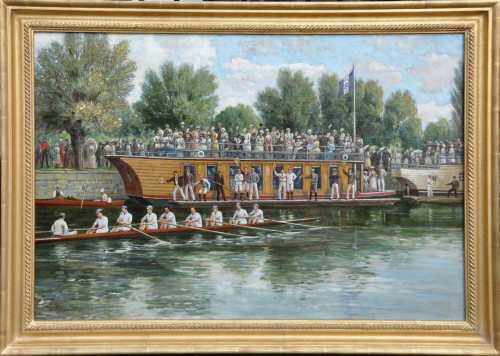
A view on the River Thames off Erith, with a Royal Navy frigate under sail
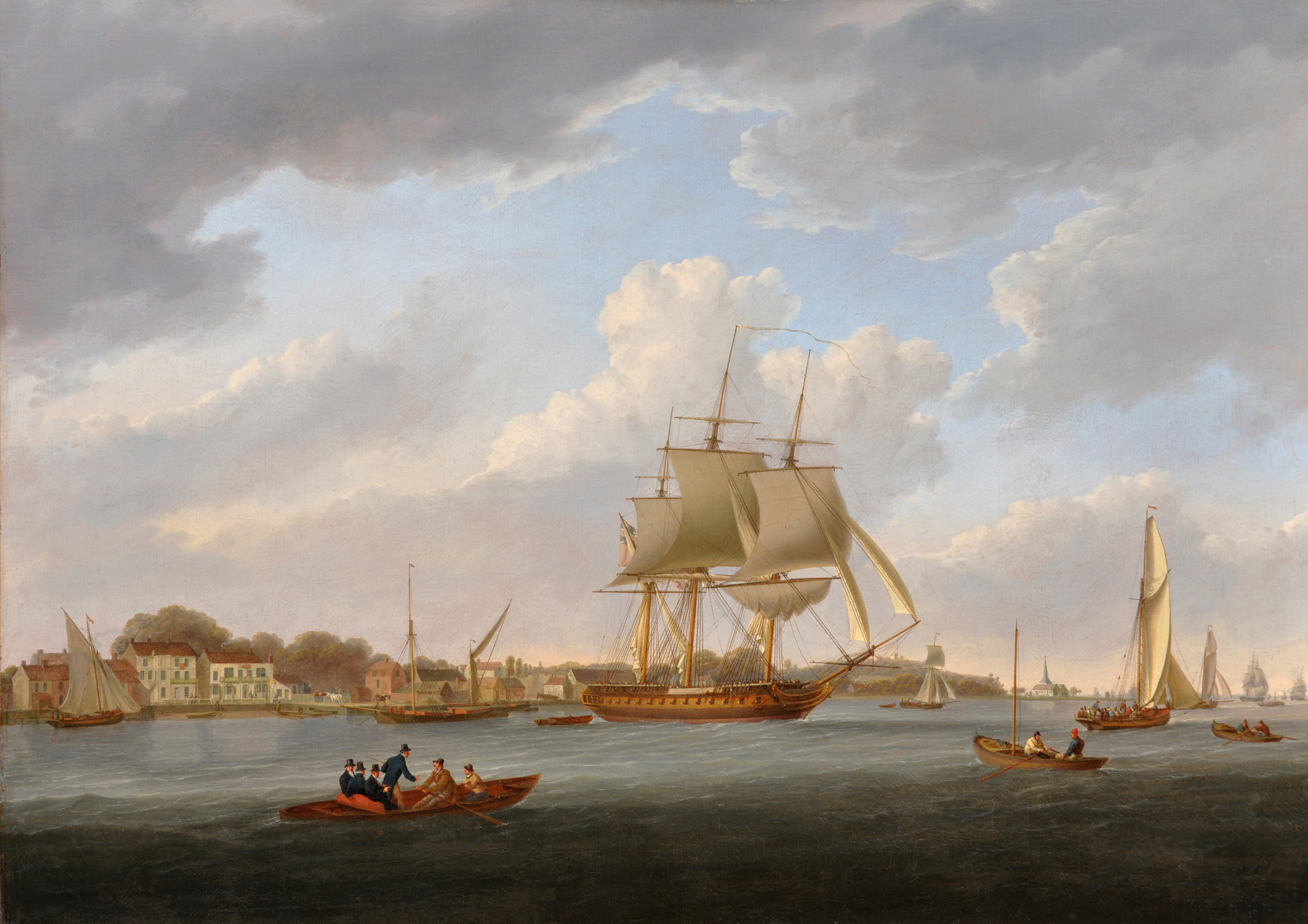
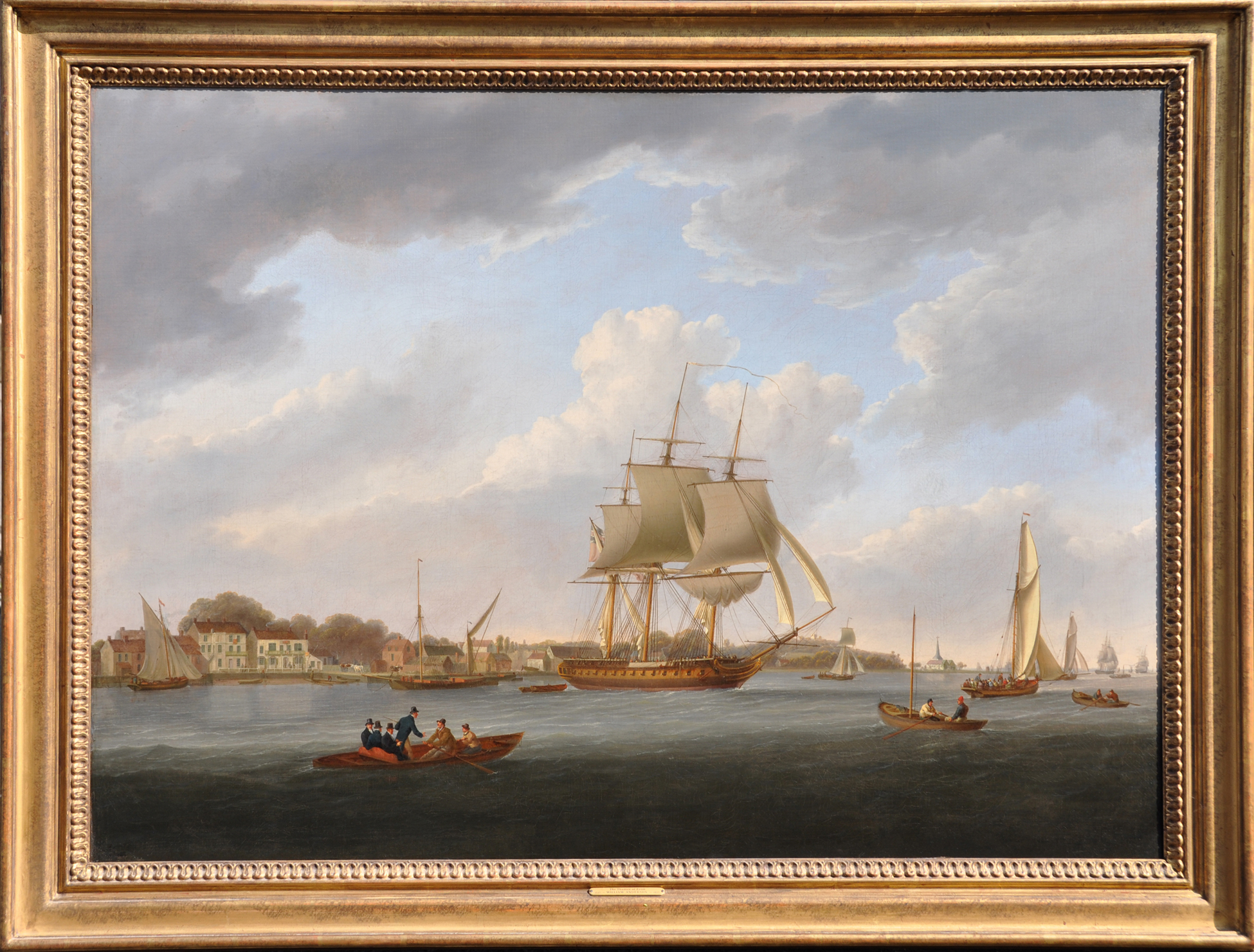
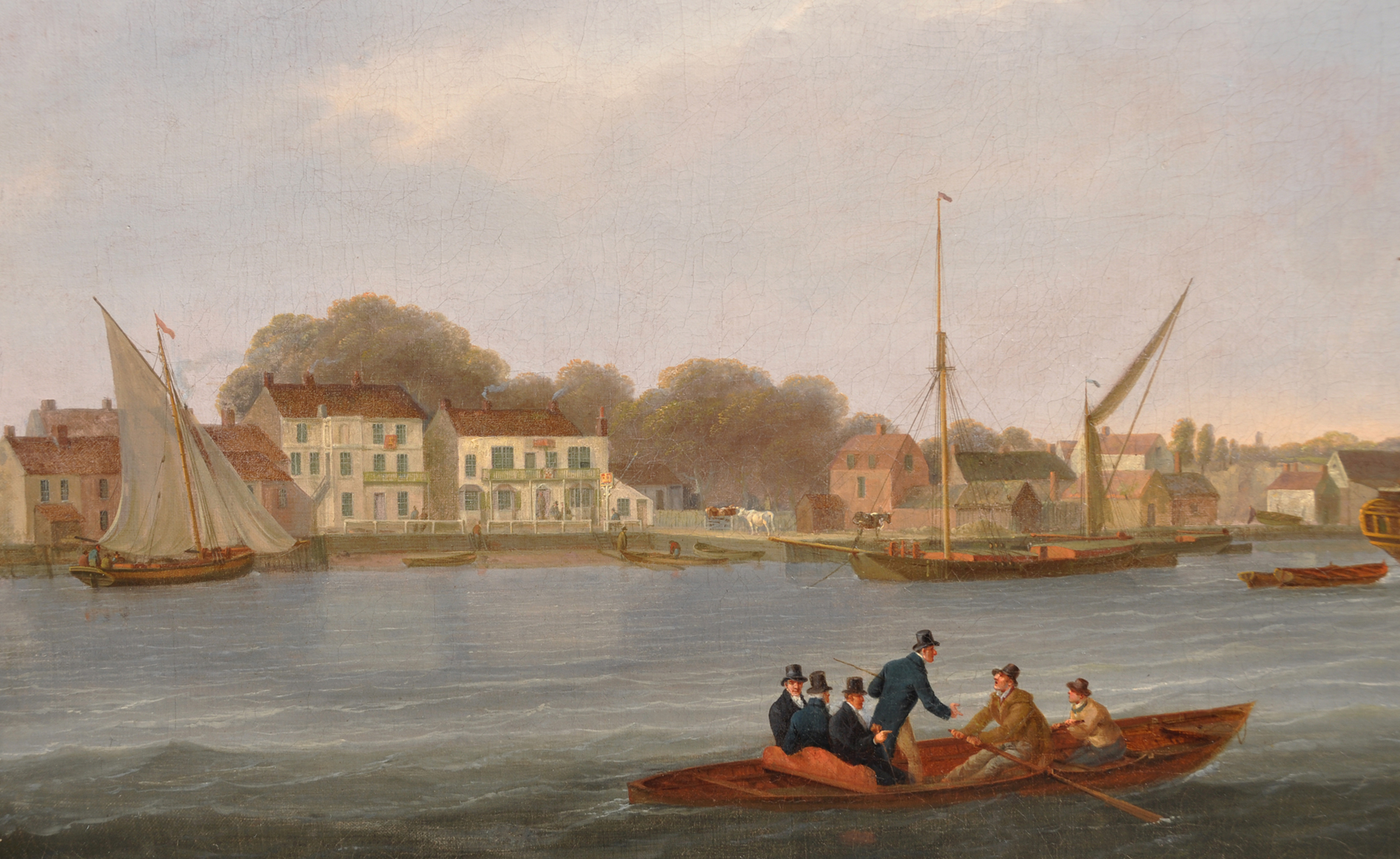
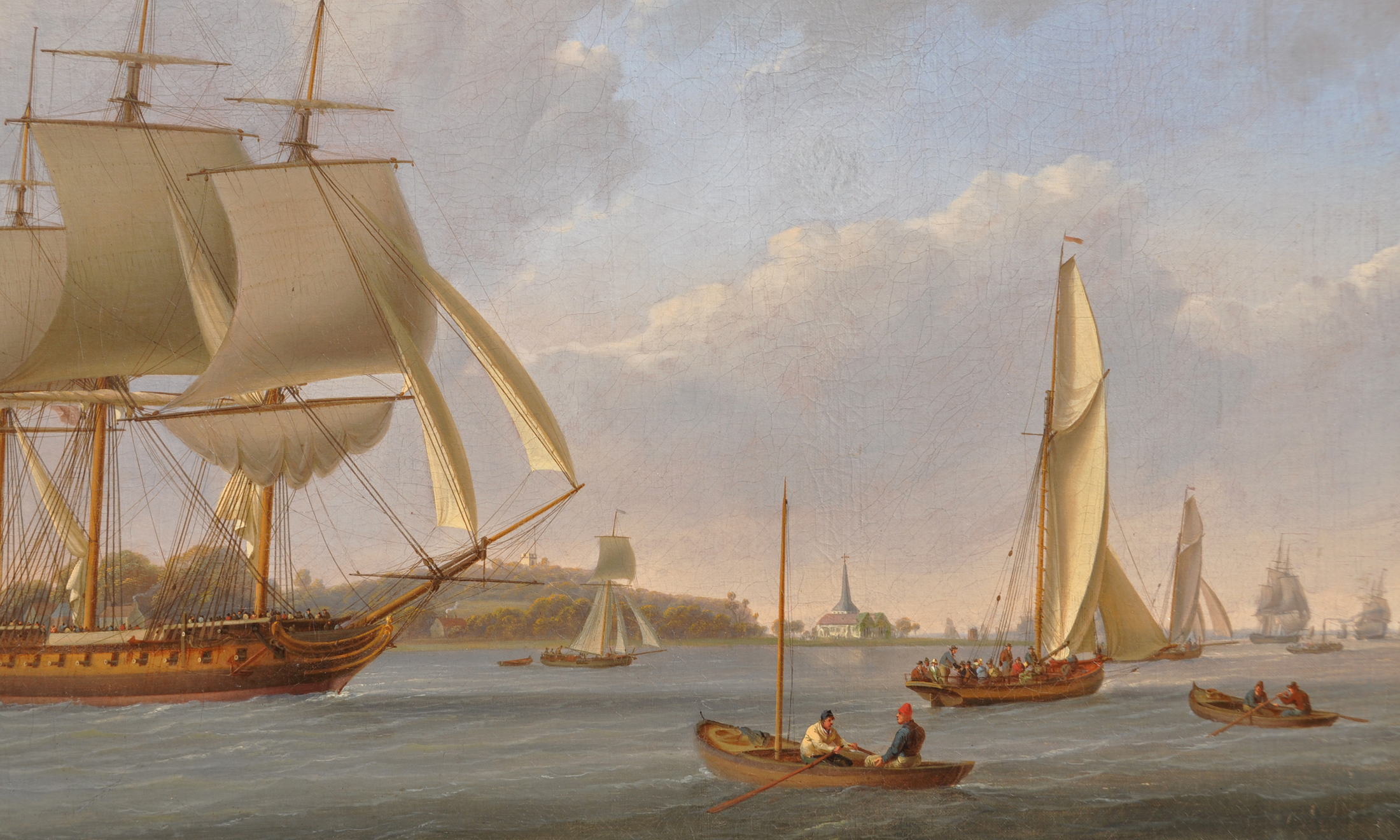
A view on the River Thames off Erith, with a Royal Navy frigate under sail
WILLIAM ANDERSON
1757-1837
English School
A view on the River Thames off Erith, with a Royal Navy frigate under sail
Oil on canvas
80.5 x 112.4 cms
315/8 x 44¼ ins
Overall framed size 96.2 x 127.6 cms
377/8 x 50¼ ins
M H Grant, writing in The Old English Landscape Painters Vol IV, says of William Anderson that: “He is assuredly one of the most delightful of our Little Masters. Immaculate paint, drawing clean and clear, a real ‘sweetness and amenity’ of colouring and handling, a charmingly old-world choice of and treatment of subject. All this, added to handy and portable dimensions of his normal panel or canvas, characterises the oeuvre of William Anderson.”
William Anderson was born in Scotland and started employment as a shipwright in the Clyde shipyards. He came to London in 1787 with the intention of earning his livelihood as a marine draughtsman and lived at addresses in Lisson Grove and St. John’s Wood among others.
He clearly had an eye for detail and a natural ability to delineate ships but he does not seem to have had any formal instruction in paintings. However, he was known to spend a considerable amount of time working at paintings and an observation was made by Edward Dayes, the watercolour painter and engraver that “…he employed his leisure hours in the art of painting.” His aptitude was remarkable for he soon forsook the dividers and rulers of his paid employment to set himself up as a marine painter, becoming one of the very best of that genre of painting.
Anderson was influenced by the Dutch Golden Age painters of the 17th century and his most characteristic work has an airy quality and a distinctive sense of colour that is soft and redolent of the great Dutch painter Jan van de Capelle. This aptitude translates perfectly when utilised in his best work which portrays ships in light airs and he was meticulous in his preparation for each work. One of his sketchbooks, probably from the years 1792-4, which is now in the collection of London’s Victoria and Albert Museum, is full of drawings in pencil and ink with depictions of merchant vessels and the careful delineation of the rigging, stern sections, prows and figureheads demonstrates his keen acuity for detail.
He exhibited his first work, A view on the Thames, at the Royal Academy when he was thirty years old and this was the start of a long association with both subject matter and exhibition venue as he showed at the R.A. a further 44 works, the last being a major work in 1834 with Lord Howe’s Fleet off Spithead.
The Thames formed a significant inspiration for his paintings throughout his career with examples of titles including several just entered in exhibitions as View on the Thames but others that were much more specific such as: Shipping on the Thames at Deptford; View of Billingsgate at High Water; View of East Lane Stairs, Bermondsey; Scene on the Thames near Battersea; Troops embarking near Greenwich and Limehouse Reach. Occasionally, Anderson departed from marine painting and showed a landscape such as A woody scene with Gypsies and A view from the Painter’s window (ex. In 1832 when he was living in St John’s Wood, London). There was also the Battle of Waterloo shown in the B.I. in 1822.
However, Anderson also travelled to Holland and exhibited several paintings from these travels as well as views of Hastings and a period spent in the north-east depicting Berwick-on-Tweed, Tynemouth and Hull. His time spent in the last had a significant effect on the Hull school of painters, in particular the young John Ward (1798-1849) who came to be known as Ward of Hull. Julius Caesar Ibbetson, (1759-1817) the Leeds landscape painter, was a long-time friend and the former is thought to have collaborated with Anderson on a few paintings
The production of prints, fuelled by the public’s enthusiasm for having access to more affordable art, had been steadily increasing from the 18th century and in 1800 William Elis issued a set of aquatints which were taken from the Battle of the Nile series of paintings that Anderson had done. The painter had not actually witnessed the action but had based his portrayals on pencil sketches made by Colonel Walter Fawkes who had made the studies during the conflict.
Edward Dayes, in his Professional Sketches, published in 1805, further commented that the artist was: “As a man he was singularly modest; and as an artist, the last to speak of his merits.” Regarding his artistic merits, Dayes goes on: “His style of colouring is clear and bright and his aerial perspective is well understood. The handling is clear, firm and decisive.”
A son, William Guido Anderson, also became an artist and exhibited a painting at the R.A. in 1799 with the title The Wolverine engaging two French luggers. He had joined the Royal Navy though and served as a midshipman on the Bellona but at the Battle of Copenhagen in 1801, he was mortally wounded.
Anderson exhibited 63 paintings including 45 at the Royal Academy between 1787-1834 with titles such as The Evening of February 14, 1797, off Cape Vincent; View on the Thames - a Calm with Dutch boats; A view near Gravesend; View of Billingsgate at high water; Capture of Fort Royal, Martinico, by Captain Falknor; Return of George IV to Greenwich; View of London Bridge from the east; Scene off Gibraltar with a Frigate under Reef Topsails; Lord Howe’s Fleet off Spithead and The British Squadron going to the Tagus with Spanish captured ships; Other paintings were exhibited at the Society of Artists (5), British Institution (9) between 1810-1826 and the Maritime Museum at Greenwich has nine of his paintings in its collection which includes a self-portrait. Many of his sketch books can be found in the Victoria and Albert Museum and the British Museum. Other museums and institutions which hold examples of his work include: Museum of London; National Army Museum; Government Art Collection; Walker Art Gallery, Liverpool; Sheffield Museum; Ferens Art Gallery; Leeds Museum and Art Gallery; Hall Place and Gardens; Beecroft Art Gallery; Maidstone Museum and Bentif Art Gallery; Dover Collections; Plymouth City Council; National Trust: Anglesey Abbey and Dorneywood; Yale Center for British Art has five works including A view of Westminster Bridge from the south side and also Hussars embarking at Deptford.
William Anderson died on 27th May 1837.
Bibliography:
The Dictionary of British 18th Century Painters - Ellis Waterhouse
Marine Painting in England 1700-1900 – David Cordingly
Dictionary of British Marine Painters - Arnold Wilson
The Old English Landscape Painters – M H Grant
Watercolour Painting in Britain. The Eighteenth Century – Martin Hardie
The London Encyclopaedia – Ben Weinreb, Christopher Hibbert, Julia Keay, John Keay
A Dictionary of British Place Names – A D Mills
ERITH
At the time of this painting, Erith was a small riverside port and well-used Thames anchorage on the south bank. Because the water was deeper at Erith than further upstream, some larger ships would unload some or all of their cargo there, thus reducing their displacement and enabling them to head into shallower waters further upriver. The antiquarian, Edward Hasted (1732-1812) wrote in 1797 that Erith consisted of “…one small street of houses which leads to the water side.” By 1840, this had increased to two streets with a further one leading to the church and the population was about 1,500.
Its origins go back to prehistoric times where ancient tracks met the Thames and its name, according to A Dictionary of British Place Names derives from the Anglo-Saxon or Old English word ēar hȳth for a “muddy or gravelly landing place.” However, over time its name has evolved into Earhyth in, Earhith c.960 to Erhede in 1066. In prehistory, the area was covered by dense woodland of indigenous trees such as yew, alder and oak although by the Bronze Age much of this had been cleared and replaced by sedge fen. Traces of a prehistoric settlement have been discovered and of a larger community or possibly substantial farmstead which has been dated to the first century AD. Its first appearance in recorded documents was in 695 AD when it is mentioned in a charter which recorded a grant by the Bishop of the East Saxons of land and there has probably been a church on the site of the present St John the Baptist - of Norman origin - since the time of the Anglo-Saxons. Following the Norman invasion of 1066, William the Conqueror’s half-brother, Odo, Bishop of Bayeux, was created Earl of Kent and established his manor there where it is recorded in the Domesday Book in 1086.
By the time of Henry II, the manor was in the possession of Richard de Luci but the latter’s involvement with the murder of Thomas à Becket in Canterbury Cathedral in 1170 resulted in loss of the King’s favour and as an act of penance he founded Lesnes Abbey, close by Erith in 1178. Consequently, throughout the Middle Ages, Erith was also known as Lesnes. In 1215, prior to the signing of Magna Carta, King John granted safe passage to the group of barons confronting the king and they met John’s representatives at Erith Church. In 1315 the right to hold a market each Thursday in the village was granted by Royal Charter. Lesnes Abbey featured again in 1381 when Abel Ker, the leader of the Kentish uprising which became known as the Peasant’s Revolt, invaded the Abbey with his followers
Erith achieved far more prominence when Henry VIII established a naval dockyard there although it was more for fitting out ships rather than the entire construction process. Henry’s renowned warship, the Great Harry, was one such which came from the ship building docks at Woolwich to be completed at Erith in 1515. In 1538 the Lord of the manor at Lesnes George Talbot, 4th Earl of Shrewsbury, died but his loyalty to Henry was rewarded by not having his land appropriated by the king but instead it was granted to Elizabeth, his widow, “…with all its members and appurtenances, to hold in capite, by knight's service.”
The town grew in size and importance as a river port although it was still comparatively secluded compared to other Thames ports. The conspirators involved in the Gunpowder Plot in 1605 deemed it to be inconspicuous enough to rent the manor house in order to discuss their proposed act of major treason.
By 1831, the population of the town had grown to 1,533 but still only had two principal streets. In 1842, a pier and pleasure gardens were built with a hotel on the sea front added shortly after and, for a while, it was a popular destination for day trippers arriving by rail or on pleasure boats along the Thames. The pier remains the longest in the London region. Two disasters affected the town in the 19th century: the first occurred on 1st October 1864 when two barges ferrying 46 tons of gunpowder exploded. It caused considerable alarm as the restraining river wall was partially destroyed which potentially exposed a large area of north Kent to flooding. The threat was averted however when a local engineer managed to fill the breach before high tide, assisted by a large group of soldiers and navvies. The second disaster, which remains the worst ever catastrophe on a British inland waterway, was the sinking of the pleasure steamer the Princess Alice on the evening of 3rd September 1878. The Princess Alice, with about 700 passengers, was returning from a day trip to Sheerness when inexplicably it collided in Gallions Reach with the Bywell Castle, an iron-built collier of 890 tonnes headed out of Millwall and bound for Newcastle. Within five minutes, the Princess Alice broke in two and sank. Only 69 were saved and it is thought that because of the high river pollution in that area, many died from poisoning rather than just drowning. The subsequent Enquiry found the captain of the pleasure boat, who drowned, culpable for cutting across in front of the collier.
The railway had come to Erith in 1849 when it was connected to the North Kent Railway and this saw a rapid expansion in the size of the town, not just in residential properties but also industrial. Large companies with international reach included the Callender Cable Co. and because of its proximity to the Royal Arsenal at Woowich, the Maxim-Nordenfelt Gun Co., which later became Vickers, and it was important in the production of guns and ammunition during the First World War. During the Second World War, Erith suffered heavy destruction from German bombing and the town never really recovered as an industrial centre.
It was part of the county of Kent until the redrawing of boundaries when it was subsumed into Greater London in 1965 becoming part of the London Borough of Bexley.
RELATED ITEMS